
Platform · The operating model
A faithful model of how your organization works
The operating model captures how your organization really runs: your definitions, rules, roles, and approval paths, as your people use them rather than as the org chart describes them. Every Authentica agent is held to it. You own it, and your people review every change.
01What it is
What is an operating model, in plain terms?
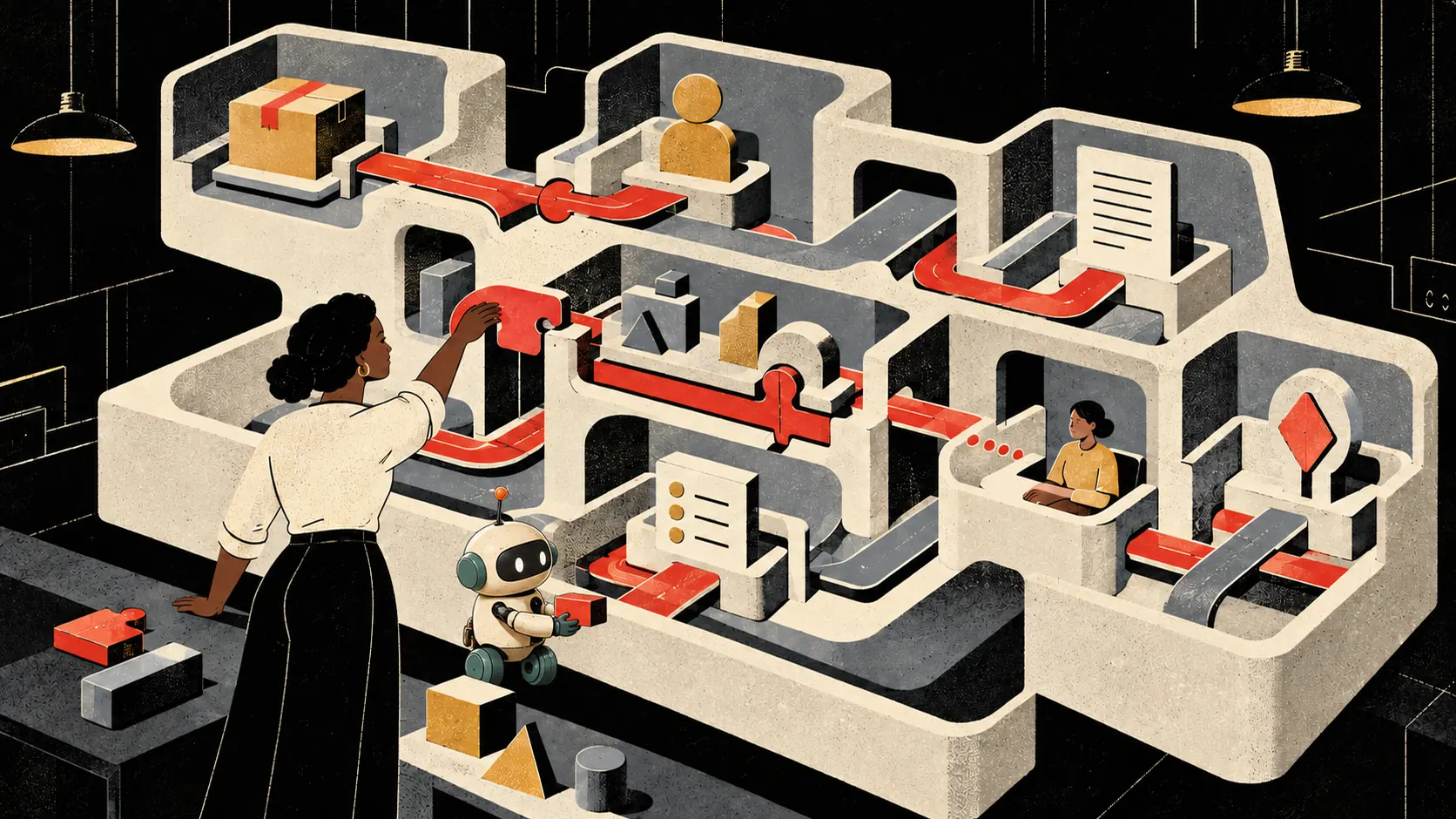
It is a structured, living representation of your business: your trade lanes, carriers, logistics, SOPs, compliance obligations, and suppliers, everything connected and in context. It is not a database and it is not a dashboard. It is the difference between AI that pattern-matches on raw data and AI that understands your operation.
When an agent sees an exception, it knows which carrier, which trade lane, and which SOP applies, because the operating model tells it. Optimize one step without it and you usually break the system. We model the whole operation first, so every improvement lands downstream too.
02What lives in it
What lives in the operating model
Every part of your organization is represented, connected, and kept current, across operations, finance, IT, and supply chain. Agents use these relationships to know what applies and what to do next.
01
Records and definitions.
Purchase orders, invoices, vendors, shipments, assets, and the other records your organization runs on, each defined in your own terms and connected to the records it depends on.
02
Roles and approval paths.
Who owns what, which actions each role can take, and which steps wait for a named person to approve. Roles cover people and agents alike.
03
Workflows.
Each defined piece of work: its steps, the agent responsible for them, and the steps that wait for a person, whether the work sits in finance, IT, or the warehouse.
04
Rules and obligations.
Your SOPs, policies, and compliance obligations, mapped to the records, roles, and workflows they govern. Agents know which rules apply to which work, and the platform enforces them on every action.
03How it's built
Built in under an hour
We build it from your conversations and your existing documentation. External data maps to your model automatically, no manual transformation, no custom code. A working version can be built in under an hour, which is what makes Authentica fast to deploy.
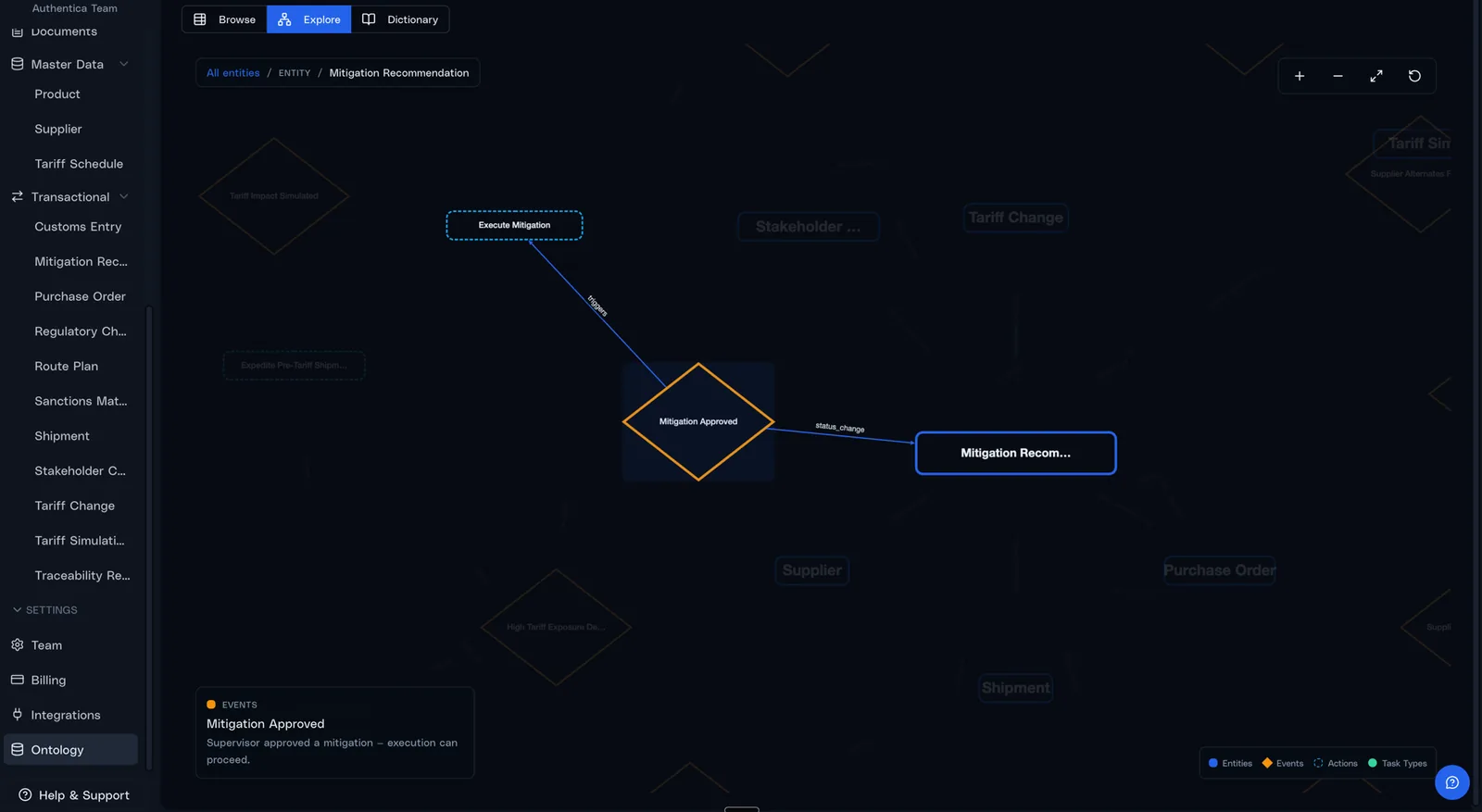
real product UI · exploring the live model · an approval event, the recommendation it releases, and the action it triggers
04Why it matters
The model is what makes AI reliable
Capability comes from the model you rent. Correctness comes from the operating model you own and the run-time enforcement that holds the agent to it. That is why a cheaper, lower-rated model can match a frontier one on the same governed work, and why your correctness doesn't change when the model does.
The model you rent is a commodity. The operating model you own is where your competitive edge actually lives, which is the argument in Intelligence Sovereignty.
Measured on a multi-stage compliance workflow
From about 30% reliable to about 97% reliable, end to end, with the operating model and run-time enforcement.
Source: Borg white paper, The Model Is Not the Product
How you know it is faithful
Before go-live, your operating model is graded against scenarios drawn from your own operation, and every miss your team flags becomes a test case before it can recur. After go-live, every proposed change is graded the same way before it ships. We have also tested the method in public: we wrote down the approval rules for part of a large open-source project from six months of its history, then replayed six months we had not seen. See the worked example
05How it decides
The right kind of intelligence for each decision
Authentica is designed so each decision is made by the kind of intelligence suited to it. Known rules are enforced by plain code, and an AI model is used only where judgment is needed, sized to the question.

01
A person decides what to build.
Before anything is built, the AI forward-deployed engineer writes a plain-language build brief and someone on your team approves it. Only your team can judge whether a design is what the business wants.
02
Large models draft.
Large reasoning models do the open-ended work, like reading your documents and drafting a change to your operating model. What they draft is reviewed before it goes live.
03
Small, fast models answer narrow questions.
Some questions are narrow: yes or no, which of these, how much. The platform is designed to send these to small, fast judgment models that say how confident they are, ask a person when they are unsure, and point out gaps without ever filling them in.
04
Code enforces the rules.
Where a rule is known, plain code applies it the same way every time. The engine validates designs as they are written, and Studio rehearses every workflow a proposed change touches against your live records without changing anything or calling a model.
05
Proofs check the checkers.
The checks are software, and software can have mistakes. We use mathematical proofs to confirm the checks behave as intended, starting with the rules that decide who must approve what.
What this means for cost
Reliability comes from your operating model and the checks around it, so the model doing the work doesn't have to be the biggest or most expensive one. When we put a model 60% less capable through the same evaluations, it reached the same 97%. Small, fast models are cheap and quick enough to put a judgment check on every step, where paying frontier-model prices for simple yes-or-no questions would add up fast. And because your rules live in the operating model you own, you can change model vendors without rebuilding how your business runs.
06Where it runs
The model travels with you
Because your correctness lives in the operating model you own, not in the tool that runs it, the model is not tied to one framework, one cloud, or one vendor's word for what happened. Today it runs across runtimes, inside your own infrastructure, and signs what it does, so the work goes where you need it to.

01
Any runtime.
The same operating model governs your agents the same way whichever framework they run on. Change the underlying tools and the rules your agents are held to do not change.
02
Your infrastructure.
The enforcement runs where your data already lives, inside your own network. What crosses the boundary is a signed record that an action was checked and allowed, never the data it touched.
03
A record you can prove.
Every governed action becomes a signed entry recorded against the exact version of the rules it was checked with, so the audit trail is evidence a reviewer can verify, not a log you have to be trusted about.
See your business as AI sees it
We build your operating model from a few conversations and your SOPs. Your team can be live in weeks, not months.