

Platform · AI agents
Agents that decide and do
Ask Kate in Console and she gives you the answer or hands the work to the right specialist, which runs it end to end. We connect the dots, recommend the next move with the evidence behind it, do the work, and show the receipt. You approve what matters.
01It runs where your team already works
Not a chat box your team will ignore
If you have tried an AI tool that was just a prompt box, you already know how that ends. Nobody used it. In Console, a request turns into governed work: a plan you confirm, approvals that come to you, and a record of everything it caused. And the agents run inside the systems your team already works in, the WMS, the TMS, the AP inbox. Work shows up the way work already shows up: things to approve, an alert when something needs a human, and screens built for the task.
The conversation is one way in, not the product. And if your TMS only does 90% of what you need, we build the missing 10% as real screens your team uses, and those screens are yours to keep.
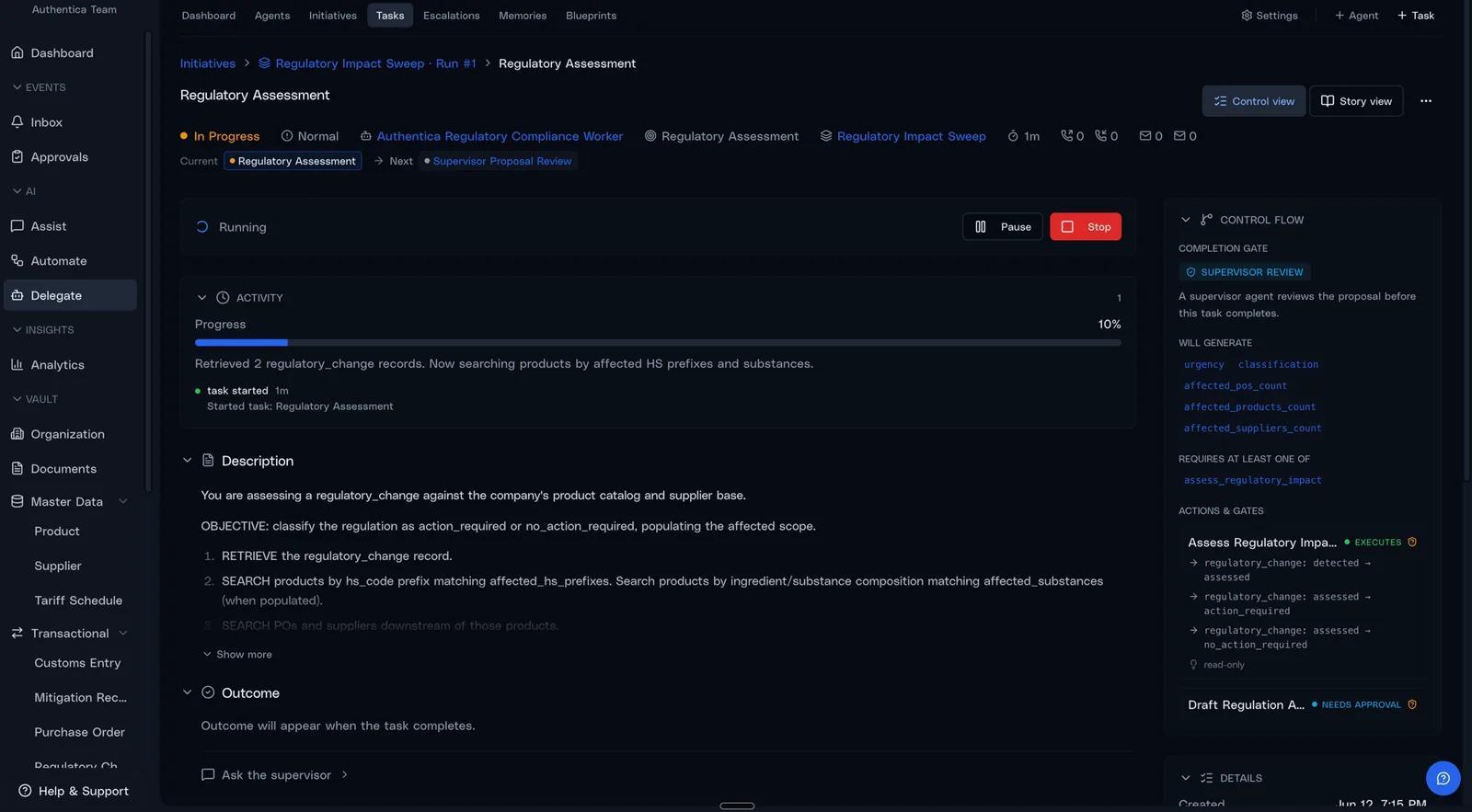
real product UI · a delegated task mid-run · the completion gate routes the proposal to a person before anything ships
02Three surfaces
Three surfaces, one operating model
Talk to the agents in one place, watch them in another, and build what they run on in a third. All three share the same operating model and data.
Console
Ask, plan, approve.
The front door. Ask Kate in plain language, see what the agents are doing, and decide approvals in the conversation that raised them. See Console
Delegate
Watch and steer the fleet.
Every agent, workflow and task in one view, with the audit log behind them. Keep full oversight or raise the autonomy as your confidence grows.
Studio
Build what they run on.
Where a new workflow becomes a reviewed change to your operating model, drafted by agents and signed by your experts. See Studio
03What ships with the agents
Pre-built skills
Agents ship with tested, validated skills for common supply chain work. Start one from
Console with /, or let a workflow run it on schedule.
Skill 01
Freight and tariff audit.
Compare charges against contracted rates, flag overcharges, prepare recovery documentation with the evidence.
Skill 02
Document processing and extraction.
Extract data from trade documents, compare against specs, flag discrepancies, file to the right shipment.
Skill 03
Compliance verification.
Verify regulatory compliance after each shipment, check documentation, flag deficiencies, recommend corrections.
Skill 04
Supplier risk scoring.
Cross-reference supplier documents and performance history, maintain a rolling risk score for every supplier.
Skill 05
Customs entry verification.
Verify entry data and tariff classifications against official sources, flag issues for review.
Skill 06
Audit-readiness.
Compile open exceptions, overdue resolutions, and documentation gaps into a single audit-ready summary, on demand or on schedule.
04Trust and control
You set the autonomy. We keep the seatbelt on.
Start with full oversight and review every action. As confidence grows, raise the autonomy for routine work while edge cases escalate to your team. Agents know what they don't know: when something is ambiguous, they stop and escalate instead of guessing. Every decision is logged in an immutable audit trail. The autonomy level is configurable per workflow, per agent, per team.

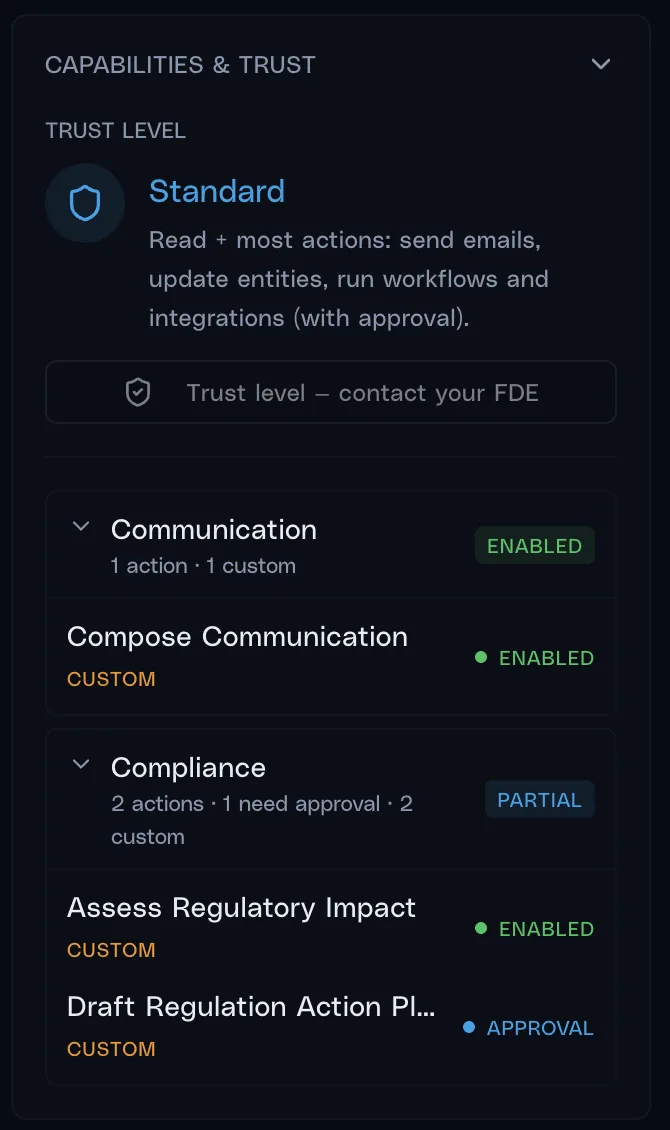
real product UI · every capability is enabled, gated on approval, or off
Ready to put agents to work?
See how Console, Delegate, and Studio work together on your own use cases in a live demo.